

May 2026
The Last Obstacle
The targets are identified. The ground is open. One transaction converts a decade of structural intelligence into a secured mineral asset.
Between 2019 and 2023, Subterrane conducted four years of fieldwork across northern South Africa – ground truthing across Thorny River and Marsfontein, drone surveys, FDEM, microdiamond sampling, and ground magnetics. Five shallow kimberlite bodies were identified and validated. Each was resolved through gravitational architecture before it was confirmed by geophysics.
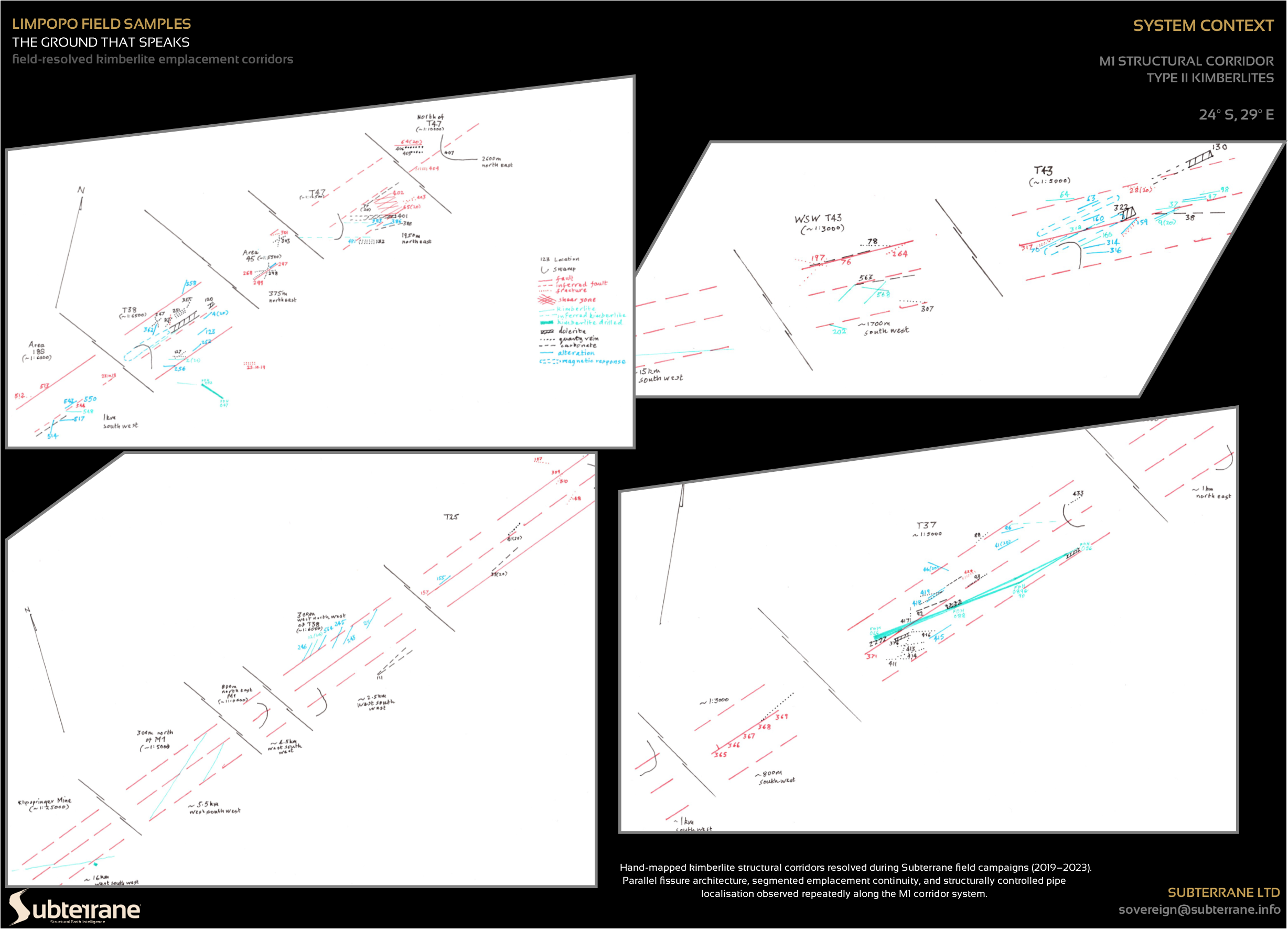
Three bodies are resolved east and north of M1 – outside prior licensed acreage, on open ground. Marsfontein was one pipe. The corridor holds more.
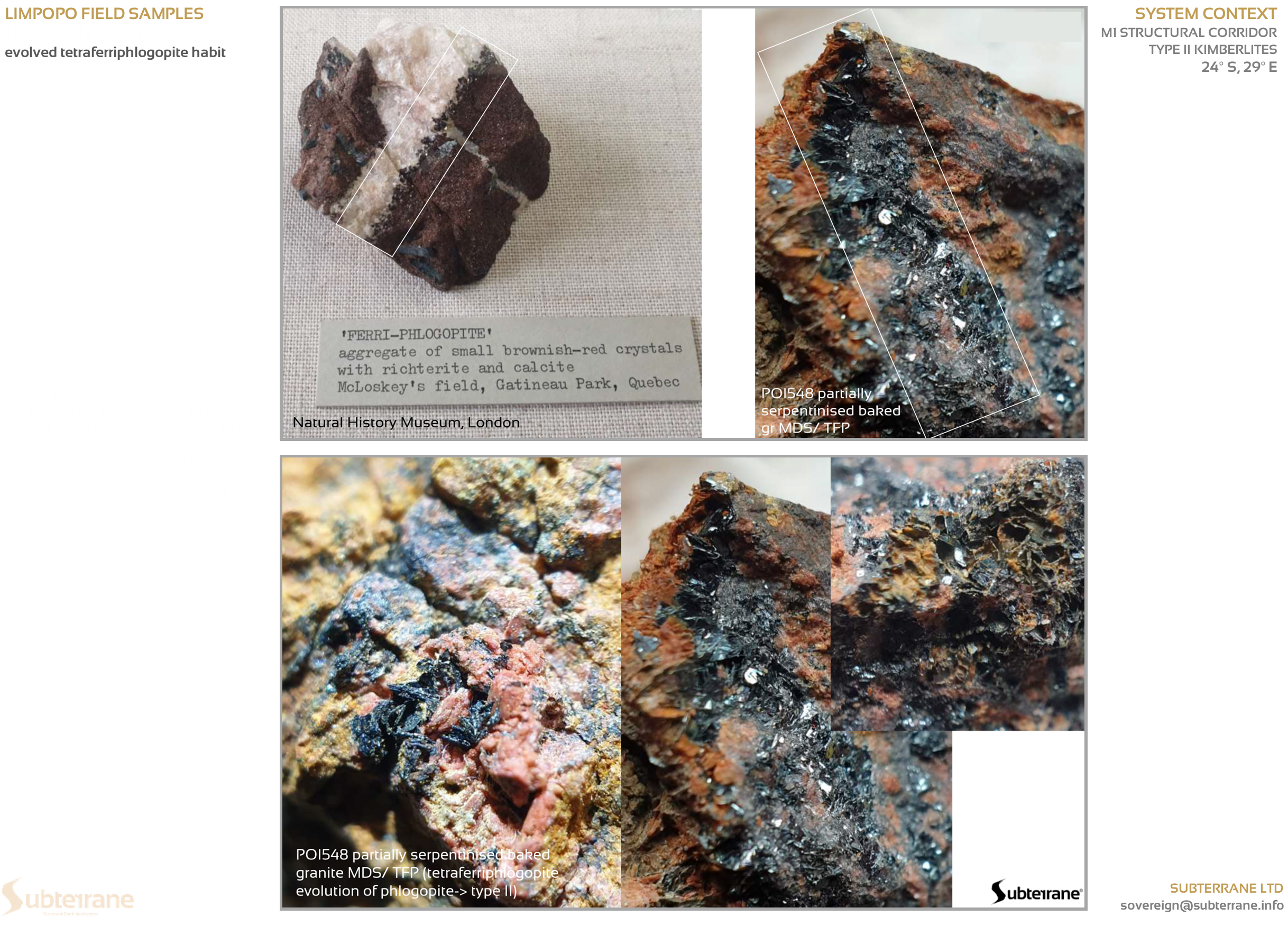
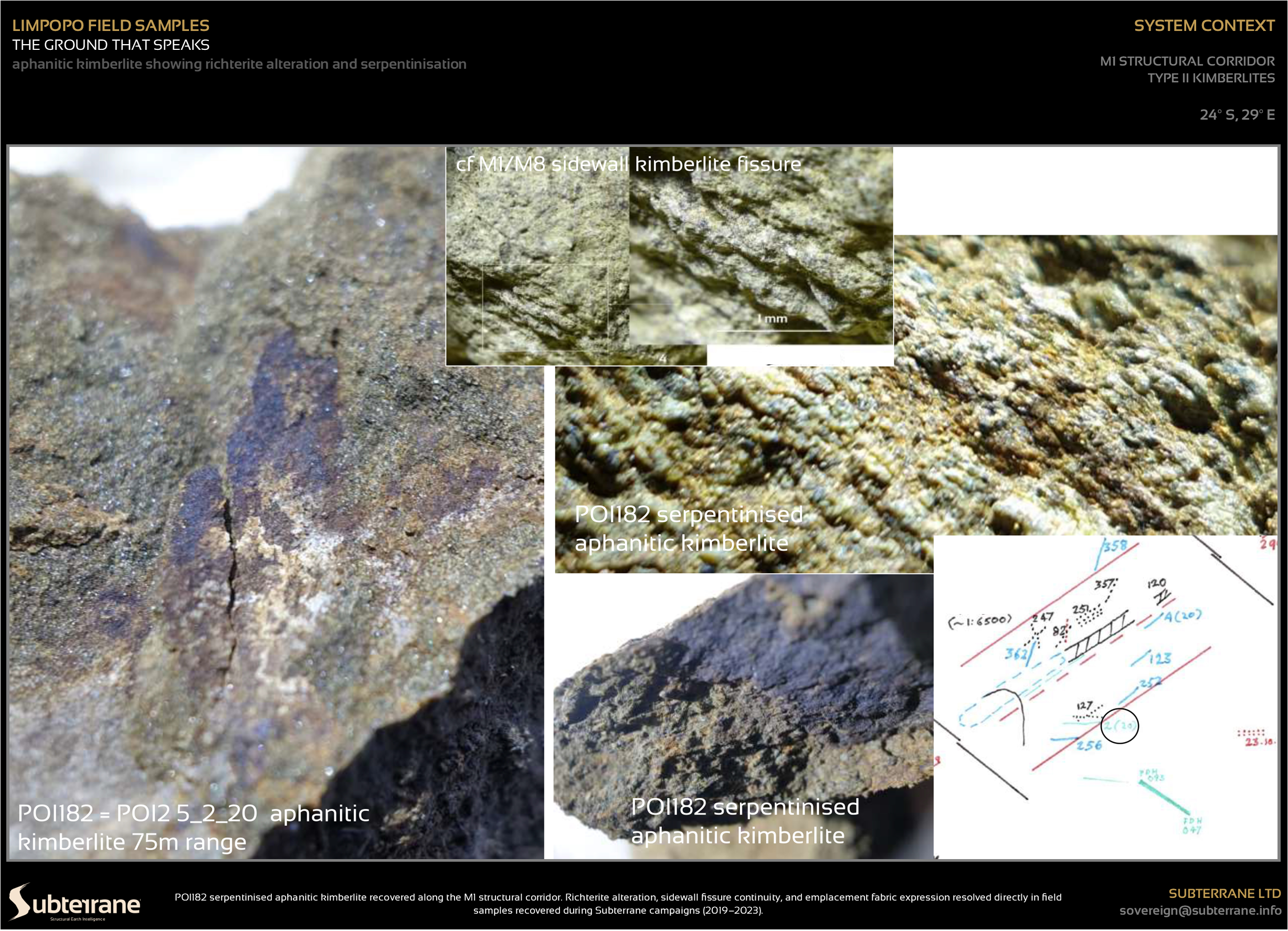
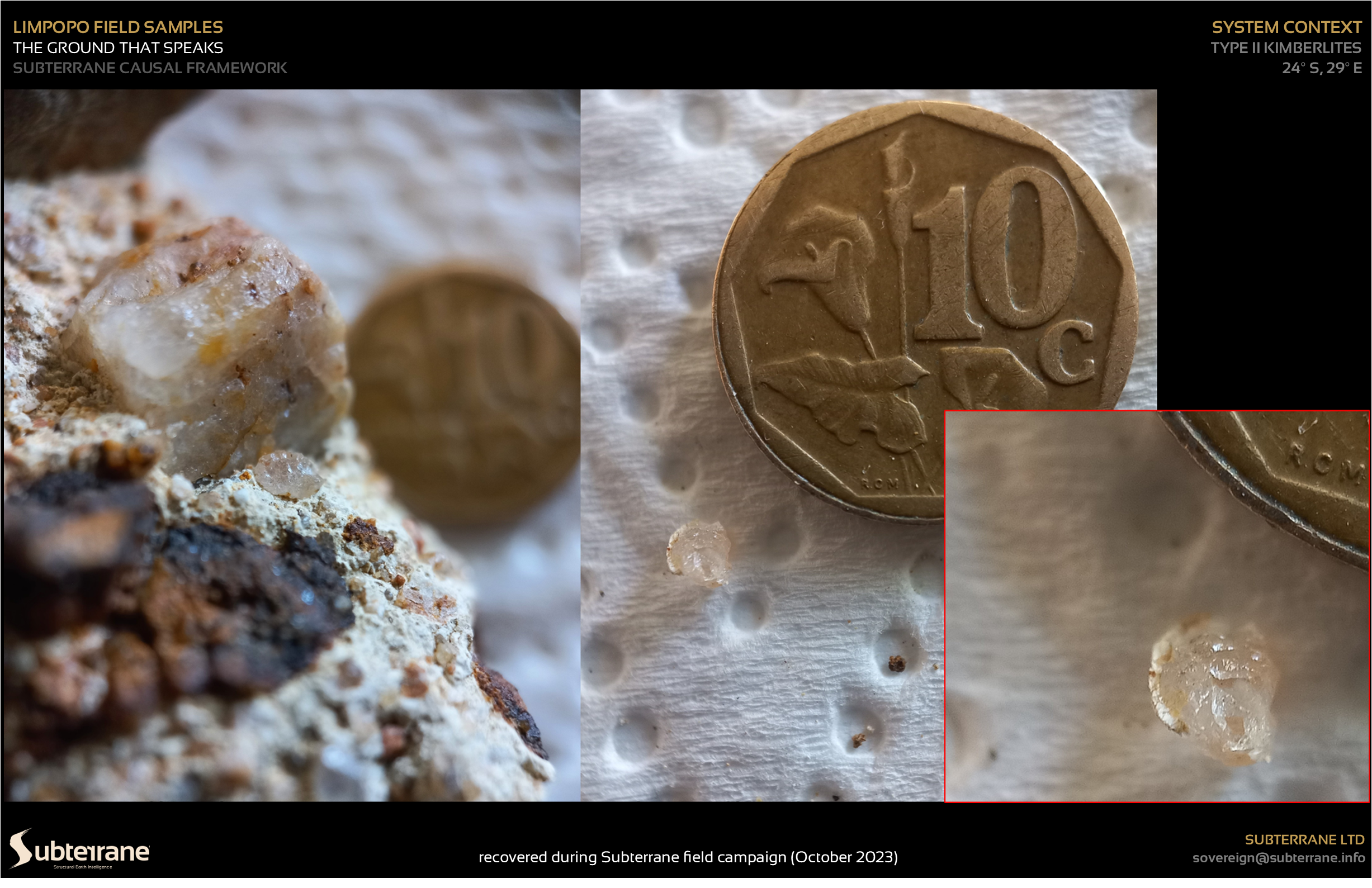
Along the M1 structural fault system – a major northeast-trending structure where kimberlite has already been proven by drilling, extending west of M1 and tracking east – fieldwork recovered tetraferriphlogopite, aphanitic kimberlite at surface, ferricrete alteration, microdiamond floaters, and in October 2023, a physical diamond recovered from the corridor. It was left with the farmer’s wife. It remains there.
The new generation of targets lies along the M1 structural trend: shallow emplacement, blow-type bodies, low overburden, low OPEX extraction profile.
Early surface grades at Marsfontein exceeded 1,500 carats per hundred tonnes. The grade tapered with depth. The shallowest material is the highest grade. The lowest-cost extraction interval is the highest-value interval.
One thing remains: securing the ground.
- 1Secure exploration licenses on high-priority M1 corridor blocks in South Africa before the window closes
- 2Lock exclusivity – prevent competitor entry into Causality Lens™-identified acreage
- 3Launch initial drilling to convert structural resolution into physical confirmation and hard asset
Kimberlite pipes don’t form randomly. They form along vertical gravitational flow channels rooted at 150–300 km depth – the same deep structural architecture that governs fault connectivity and seismic cascade. The system that reads earthquake stress in Central America reads diamond emplacement in Southern Africa by the same method. Same physics. Different surface expression.
Conventional exploration searches for patterns in historical discoveries. The Causality Lens™ reads the structure that causes discovery. That distinction produces a different class of target: not a ranked probability, but a structural inevitability.
The Marsfontein M1 pipe – 0.1 hectares at surface, mined to approximately 150 metres depth – produced recovered grades exceeding 170 carats per hundred tonnes over a 26-month mine life. Estimated total revenue exceeded US$240 million from a single shallow pipe. That is structural concentration expressed economically. The corridor east of M1 carries the same emplacement grammar.
| KoBold Metals | Subterrane | |
|---|---|---|
| Method | Pattern recognition on historical data | Structural causality – reads why |
| Output | Ranked probability | Structural inevitability |
| Capital raised | $400M+ | $350,000 ask |
| Asset status | Still identifying targets | Drill-ready, South Africa M1 corridor |
| What you’re buying | Exposure to a platform | A secured mineral asset |
Either this is funded in the current window.
Or it is funded by someone else.
There is no third outcome.
The only question is who moves first.
The ask here is $350,000 – to drill what the structure has already located.